


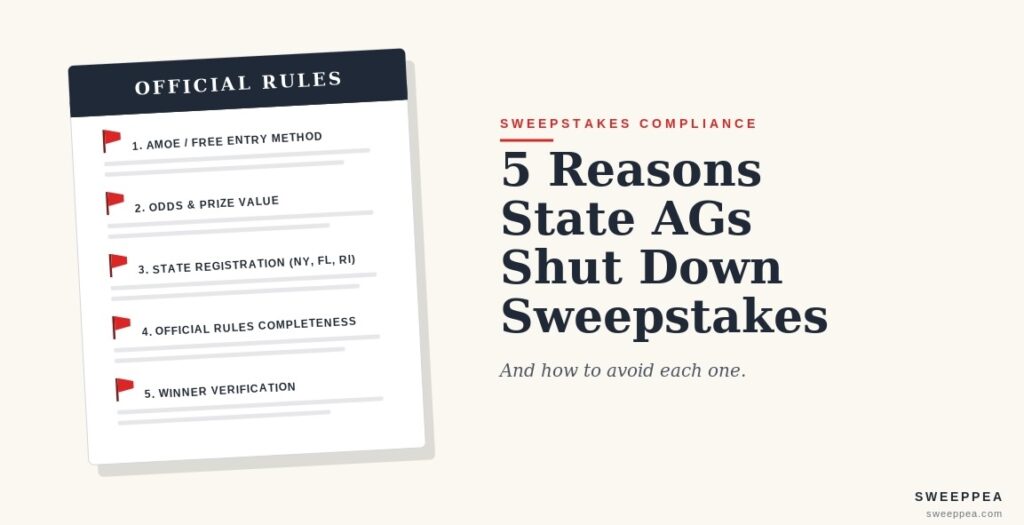
Quick answer: State attorneys general don’t audit sweepstakes at launch. They audit when something breaks: a complaint, a winner dispute, a viral moment, a regulator’s tip. The five most common failures that trigger action are missing AMOE, misrepresented odds, missed state registrations, vague official rules, and sloppy winner verification.
Most brands get the compliance conversation backwards. They worry about whether the sweepstakes is legal on day one, then never revisit it. State AGs don’t work that way. They almost never audit at launch. They audit when there’s a reason to look, and by then the structural problems have been baking in for weeks.
Here are the five compliance failures that most often turn into investigations, and the fix for each.
1. Missing or Non-Defensible AMOE
The number one trigger. A “buy to enter” promotion without a meaningful free-entry path is an illegal lottery in the U.S., full stop. Hiding the AMOE in microscopi rules text, requiring postage that costs more than the product, or weighting paid entries 10x against free entries: all of these fail the “defensible AMOE” test. The fix is equal-odds AMOE, clearly disclosed, easy to find, and easy to use..
2. Misrepresented Odds or Prize Value
This is where the FTC also gets involved. Advertising “1 in 10 chance to win” when the real odds are 1 in 100,000 is consumer deception. Inflating prize value (“$10,000 vacation!” when the package retails for $2,500) is the same problem. The fix: state odds honestly (“Odds depend on the number of eligible entries received”), use real retail value, and document how you calculated it.
3. Missed State Registration and Bonding
New York and Florida both require sweepstakes registration and bonding when the total prize pool exceeds $5,000. Rhode Island requires registration (no bonding) when the prize pool exceeds $500 and the sweepstakes has physical retail-display advertising. Skip these and your promotion is operating illegally in those states from the moment it goes live. The fix is to file before launch, or to geo-exclude those states and enforce the exclusion in your rules. The Sweepstakes & Contest Laws by State reference covers the rest.
4. Vague or Missing Official Rules
Official rules are the legal contract that governs your promotion. The most common gaps: no clear sponsor identification, no start/end dates with time zone, missing prize substitution language, no eligibility geography, no winner notification process, no governing law. Any of these gives a disputing entrant, or a regulator, a wedge. The fix is a complete rules document covering every standard section before the first entry is accepted.
5. Sloppy Winner Verification and Notification
Picking a winner is the easy part. Verifying they’re eligible, of age, in an eligible state, and not on a prohibited list is where many brands fall apart. Sending a prize to someone who turns out to be ineligible, or failing to notify alternates on a documented schedule, creates winner disputes that end up in regulator inboxes. The fix is a documented verification protocol (affidavit of eligibility, signed publicity release, residency confirmation, age verification) and written alternate-winner procedures.
The Common Thread
Four of these five failures vanish when a sweepstakes administrator handles the operational side. Sweeppea’s full-service administration bakes in AMOE structure, state registrations, official rules, and winner verification by default. For DIY operators, the self-service platform includes the same compliance scaffolding without the agency layer. The fifth failure, accurate odds and prize value disclosure, sits with the brand, but a good administrator will flag it during review. Sweeppea has administered hundreds of promotions across all 50 states and Canada since 2010, which means most of these failure modes are already engineered out.
Frequently Asked Questions
Can a state AG actually shut down a sweepstakes mid-campaign?
Yes. State attorneys general have cease-and-desist authority and can require a promotion to stop accepting entries, redraw winners under supervision, or refund considerations. Serious cases bring civil penalties and injunctions. The reputational damage tends to be worse than the fine.
What’s the most common trigger for a state AG investigation?
Consumer complaints, usually from someone who feels the AMOE was inaccessible, the odds were misleading, or the winner selection looked rigged. Regulators rarely look proactively. They follow complaints, and complaints follow promotions that feel unfair to participants.
Do I need to register a sweepstakes if I’m geo-excluding NY, FL, and RI?
No. If your official rules explicitly exclude residents of New York, Florida, and (when triggered) Rhode Island, you don’t need to register in those states. The exclusion has to be enforced at entry, not just stated. Many smaller campaigns choose this path to avoid the registration and bonding costs.
Visit Sweeppea’s Web Platform for list building or check out our Shopify App for sales growth.
Questions? We’re here to help:
- Email: support@sweeppea.com
- Phone: +1 (888) 705-2049