
Discounts are a trap. Run enough of them and your customers start waiting — for the next sale, the next promo code, the next 20% off. You trained them to do it. You can untrain them, but it takes a while, and it hurts.
Buy-to-enter sweepstakes work differently. Instead of cutting your margin to move product, you’re adding upside. Customers buy because there’s a chance to win something real, not because the price dropped. The full-price purchase is the ticket.
That’s a fundamentally different psychological lever, and it shows up in the numbers.
What “Buy-to-Enter” Actually Means
A buy-to-enter sweepstakes ties entry to a purchase. Every order earns the customer a chance to win a prize ($1 = 1 entry) — awarded by random drawing at the end of a defined sweepstakes promotion period.
The most common entry structures are:
- Per order: one entry per transaction, regardless of size
- Per dollar spent: one entry per $X spent (e.g., one entry per $25)
- Per unit: one entry per qualifying product purchased
Per-dollar structures are the most effective for driving AOV. When customers know that spending $75 earns 3 entries and spending $25 earns 1, a surprising number will round up their cart.
The AMOE Requirement (and Why It’s Not a Big Deal)
Here’s the legal piece you need to know: in the United States, any sweepstakes that requires a purchase must also offer a free, no-purchase-necessary alternative method of entry (AMOE). This is what separates a legal sweepstakes from an illegal lottery.
The AMOE has to be real — equal odds, genuinely accessible, not buried. It typically takes the form of a mail-in entry or a free entry form on a landing page. It doesn’t have to be promoted loudly, but it has to exist and it has to work.
Most brands running Shopify sweepstakes worry about this more than they need to. In practice, almost no one uses the AMOE. The customer who wants to win is the customer who’s already buying. The free entry path exists for compliance; it doesn’t meaningfully dilute the pool.
Sweeppea handles the AMOE setup automatically as part of the promotion structure, so it’s not something you have to engineer from scratch.
Why It Lifts AOV
This is the part that often surprises brands. A sweepstakes with per-dollar entries doesn’t just add entries — it reframes the purchase decision entirely.
Instead of “do I want this?”, the customer is asking “how many entries do I want?” That’s a different question. It shifts the mental frame from evaluation to optimization. Customers who were going to buy $40 worth of product start thinking about what it would take to get to $50, or $75, or $100.
You also get a natural incentive to increase baskt size without offering a discount on any individual item. Your margins stay intact. The only cost is the prize — which you’ve budgeted and controlled upfront.
Compare that to a 20%-off sitewide sale, where you’ve cut revenue on every order across the board to move volume.
Prize Strategy: What Actually Works
The prize matters more than most brands think.
A few things to keep in mind:
The prize should feel aspirational, not random. A $500 Visa gift card gets entries. A $2,000 prize pack of your own products gets excited customers. Brand-aligned prizes attract your actual audience, not deal hunters.
Cash and gift cards attract the wrong entrants. Someone entering to win a $1,000 Amazon gift card is not necessarily your customer. Someone entering to win a year’s supply of your product is. Prize relevance filters your entry pool toward people who actually want what you sell.
Prize value should scale with promotion duration and reach. A one-week flash sweepstakes for a Shopify store with 10,000 customers doesn’t need a $50,000 prize. A well-calibrated prize for that audience might be $500–$2,000. Oversized prizes can actually feel fake, which hurts credibility.
One great prize beats a handful of mediocre ones. The psychology of sweepstakes favors a single large prize over several small ones. People can imagine winning the big thing. Five $100 prizes feel like lottery scratch-offs.
Where the Sweepstakes Lives in Your Store
The entry mechanic runs through your checkout, but that’s not the only place the promotion needs to show up.
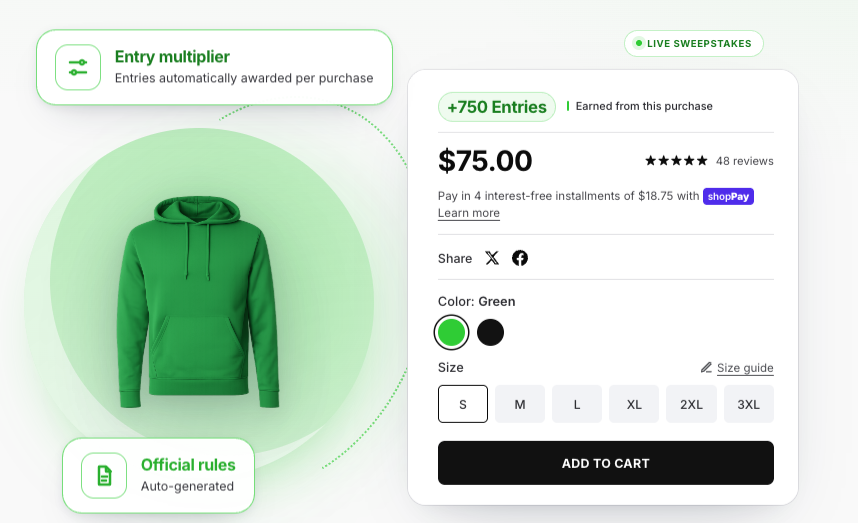
Product pages should carry a banner or badge: “Every purchase earns entries to win [prize].” This is arguably the highest-leverage placement. It meets the customer at the moment they’re deciding whether to buy and adds a reason to act now.
The cart page is where per-dollar mechanics shine. Show the customer how many entries they’ve earned based on their current cart total, and how many more they’d earn if they added another item. Some brands display this as a simple progress bar.
Post-purchase confirmation is underused. Tell you customer, email [ entires at sweeeppea.com ] to get your total entires count.
Email flows should acknowledge the sweepstakes entry on day one. A triggered email confirming entries earned — and reminding the customer of the prize and end date — keeps the promotion top of mind and creates a natural re-engagement touchpoint.
Use Cases by Brand Type
DTC brands with repeat-purchase products (supplements, skincare, coffee, pet food): Per-dollar entries work well here because customers already have a reason to buy more. The sweepstakes accelerates repurchase timing and increases bundle size.
Subscription boxes: Run the sweepstakes during a subscription sign-up window. Entry tied to first-box purchase or a multi-month commitment. The sweepstakes gives the undecided prospect a reason to commit now rather than think about it.
Niche apparel and accessories: Prize packs of your own products work extremely well in this category. The customer who wants to win your stuff is the customer who loves your brand. You’re rewarding loyalty and building word of mouth simultaneously.
Limited-edition or seasonal product drops: A sweepstakes tied to a limited drop creates layered scarcity — not only is the product limited, but there’s a prize only buyers can win. This rewards early buyers and creates urgency without manufactured discounting.
CPG brands on Shopify: Often running lighter transaction volumes, so per-order (rather than per-dollar) entry structures make more sense. The goal is purchase activation and trial, not cart padding.
Running It With the Sweeppea Shopify App
The Sweeppea Shopify app handles the mechanics so you don’t have to build anything from scratch.
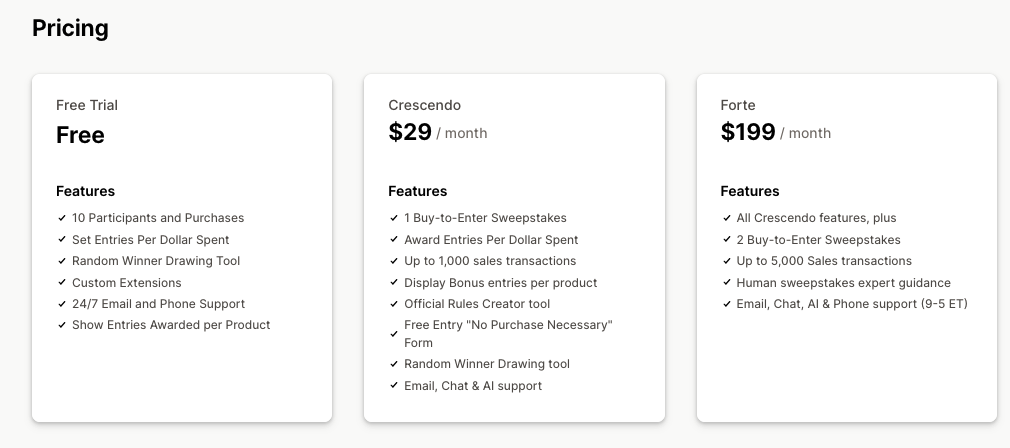
After installation, you configure your promotion — entry structure, prize, start and end dates, official rules — directly in the app. Sweeppea auto-generates the AMOE entry path and the official rules language, both of which are required for legal compliance. When the promotion ends, you run the drawing through the platform, and Sweeppea produces an auditable winner selection record.
The app integrates with your existing Shopify checkout. There’s no custom code required to connect purchase data to entries. For a deeper look at how the integration works, the Sweeppea Shopify app overview page walks through the setup flow.
One thing worth noting: if your promotion has a prize pool over $5,000 and you’re running it nationally, you’ll need to register in New York and Florida. Sweeppea’s full-service team handles that if you’d rather not deal with it yourself. For most brand-sized Shopify promotions, the prize sits below that threshold, and registration isn’t required.
What to Measure
A few metrics worth tracking during and after a buy-to-enter promotion:
- AOV during promotion period vs. baseline — this is the primary signal
- Conversion rate — does the sweepstakes incentive move undecided visitors to purchase?
- Entry volume vs. order volume — a big gap (lots of AMOE entries, few purchases) can signal the prize is attracting non-customers
- Email list growth — if you’re capturing emails at entry, this is a real secondary benefit
- Repeat purchase rate post-promotion — customers who discovered your brand through a sweepstakes can become loyal buyers if the product delivers
The Bottom Line
Buy-to-enter sweepstakes aren’t a substitute for a good product or a solid customer experience. But for brands that already have both and are looking for a way to drive purchase urgency without eroding price integrity, they’re one of the cleaner tools available.
You set the prize budget upfront. You keep your margins. You give customers a reason to buy more, buy now, and tell their friends. The mechanic is simple; the compliance setup is handled; the results are measurable.
If you want to try it for free, install the Sweeppea Shopify app and you can have a promotion live within a day.
Questions? We’re here to help:
- Email: support@sweeppea.com
- Phone: +1 (888) 705-2049