


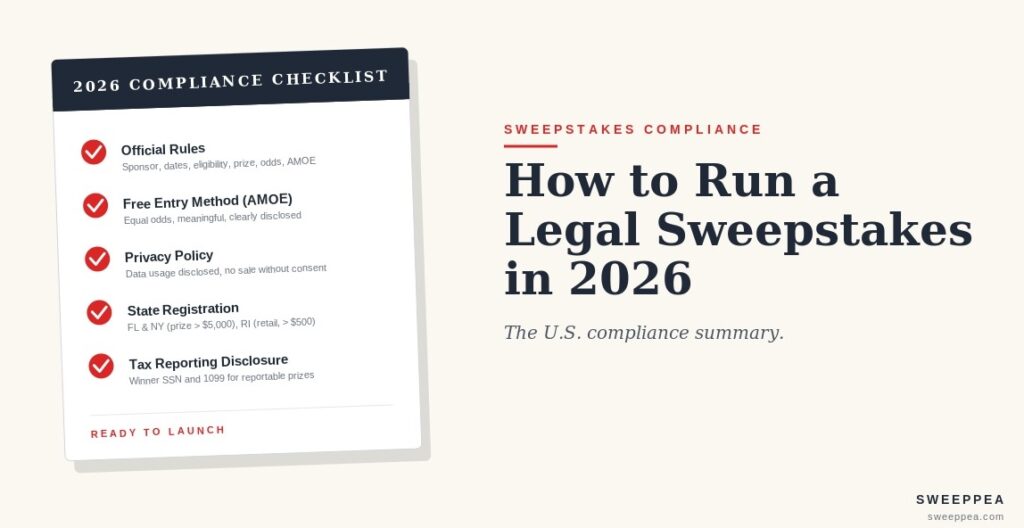
Quick answer: A U.S. sweepstakes is legal when it has a prize and is decided by a random draw, but requires no purchase to enter. The four things you can’t skip: complete official rules, a real AMOE (free entry method), a published privacy policy, and — if your prize crosses certain thresholds — registration and bonding in Florida, New York, or Rhode Island.
Running a sweepstakes in 2026 isn’t complicated. Getting the compliance wrong is what turns a growth channel into a legal problem. Here’s the short version of what federal and U.S. state law actually require.
The Two-of-Three Rule
Every promotion has three possible elements: prize, chance, and consideration (anything of value, including money or significant effort). You can have any two. You cannot have all three.
- Prize + chance = legal sweepstakes
- Prize + consideration = legal contest (judged on skill)
- Prize + chance + consideration = illegal lottery
That last line is the trap. If entering requires a purchase and the winner is picked at random, you’re operating an illegal private lottery in every U.S. state. The fix is a free entry path that removes “consideration” from paid entries.
What Every U.S. Sweepstakes Must Have
- Official Rules covering sponsor, dates (with time zone), eligibility, entry methods, prize description and ARV, odds, winner selection and notification, prize claim process, and void jurisdictions.
- A real AMOE — a free entry method (mail-in, web form) with equal odds of winning. If you offer bonus entries for paying, make sur e the AMOE also offers the same amount of bonus entires
- “No Purchase Necessary” displayed prominently everywhere people can enter.
- Privacy policy explaining how entrant data is collected, used, and stored. Don’t sell entrant data without consent.
Three States That Require Registration
Most state compliance is baked into the rules. Three states go further — they require you to register (and, in two cases, post a surety bond) before the promotion goes live.
- Florida: Register and post a bond equal to total prize ARV at least 10 days before launch when prizes exceed $5,000. File a certified winners list at the end.
- New York: Register and bond 10 days before launch when aggregate prize value exceeds $5,000. Post rules (or abbreviated rules) in any retail location and file a winners list at the end.
- Rhode Island: Register (no bonding) when prizes exceed $500 and the sweepstakes has a retail element — physical retail-display advertising or in-store entry.
Skip these and the promotion is technically illegal in that state. The clean workaround if you don’t want to register: exclude those states in your official rules and enforce the exclusion at entry. The full state-by-state picture is in the Sweepstakes & Contest Laws by State reference.
State Quirks Worth Knowing
Beyond the registration states, every state layers on its own rules. A few examples: Georgia prohibits prize substitution and can’t require seminar attendance to claim; South Carolina requires prize delivery within 10 days at no expense to the winner; North Carolina bans electronic sweepstakes machines; New York has separate rules for cannabis promotions (21+, no mail-in entries, restricted advertising channels). Read the state page before launching anything unusual — or hand it to a full-service administrator that handles the state-by-state layer as a default.
Advertising, and After the Draw
Prizes valued at $2,000 or more generally trigger IRS reporting (1099-MISC), so you’ll need the winner’s SSN — disclose this requirement in the rules. Advertising must be truthful, must not imply that purchase is required to win, and must include required disclosures. Once you’ve launched, don’t change the rules mid-promotion. Keep entry records, verify winners against eligibility, and hold documentation in case of audit.
Frequently Asked Questions
Do I need to register my sweepstakes in every state?
No. Only Florida, New York, and Rhode Island require advance registration, and only above specific prize value ($5K+) thresholds. Every other state’s requirements are covered by well-drafted official rules.
What is AMOE and can I skip it if my prize is small?
AMOE is the Alternate Method of Entry — the free path that keeps a purchase-based promotion from being an illegal lottery. You can’t skip it. Prize size doesn’t matter. Any purchase-linked entry needs an equal-odds AMOE.
Can I run a U.S. sweepstakes without registering anywhere by geo-excluding certain states?
Yes. If your rules explicitly exclude residents of Florida, New York, and (when triggered) Rhode Island, and you enforce the exclusion at entry, you don’t need to register anywhere.
Visit Sweeppea’s Web Platform for list building or check out our Shopify App for sales growth.
Questions? We’re here to help:
- Email: support@sweeppea.com
- Phone: +1 (888) 705-2049
- Article written by Claude. Edited by Marcos J. Menendez