


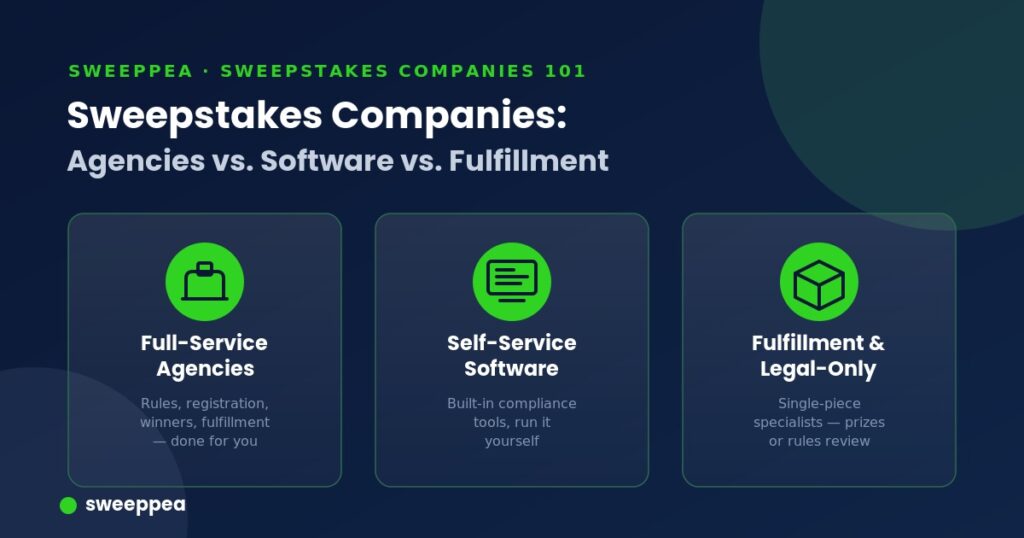
Search “sweepstakes companies” and you’ll get a pile of results that all look interchangeable. They’re not. Some of the businesses in that list will write your official rules, register you in New York and Florida, pull winners, and ship the prize.
Others will hand you a dashboard and let you do all of that yourself. A few only touch one piece — say, mailing out the prize after someone else has already run the promotion. Treating these as the same thing is how brands end up either overpaying for services they didn’t need or under-provisioned on the legal work that actually matters.
Here’s how the market actually breaks down, and how to figure out which lane fits your team.
Full-service sweepstakes agencies
This is the traditional model, and it’s still the right call for a lot of brands. A full-service agency takes the promotion off your plate almost entirely: concept and mechanics, official rules drafted by someone who’s read the state statutes, registration and bonding where requird, entry collection, winner selection and validation, and prize fulfillment. You bring the idea and the prize budget; they bring the operational and legal machinery.
The tradeoff is cost and timeline. You’re paying for labor and expertise, not just software, so a full-service promotion usually runs weeks of lead time and a per-project or retainer fee that reflects the hands-on work. For a national campaign with real legal exposure — a $50,000 prize pool, multi-state entry, a brand that can’t afford a compliance misstep — that cost is usually worth it.
Self-service sweepstakes software
At the other end, you’ve got platforms built for teams that want to run the promotion themselves. You get templated official rules, built-in entry forms, automated winner selection, and compliance guardrails (state thresholds, AMOE requirements) baked into the tool instead of explained to you on a call. It’s faster to launch and dramatically cheaper than hiring an agency for every campaign.
The catch: software doesn’t replace judgment. A platform can flag that your prize pool crosses the New York and Florida bonding threshold, but you still need to actually file the registration and post the bond. Teams that run frequent, lower-stakes promotions — a monthly giveaway, a Shopify buy-to-enter campaign, a lead-gen sweepstakes for a smaller prize — tend to get the most out of this model, because the volume justifies owning the process instead of paying an agency fee every time.
Fulfillment-only and legal-only providers
There’s also a smaller category that only does one piece of the job. Fulfillment-only companies handle prize sourcing and shipping after everything else — rules, entries, winner selection — is already sorted elsewhere. Lawyers do the opposite: they’ll review your official rules and confirm you’re compliant, but they’re not touching entry data or picking winners.
These make sense as add-ons, not as your whole solution. A brand running its own promotion in-house might bring in a lawyer for a one-time rules review, or use a fulfillment specialist for an unusually complicated prize (international shipping, a vehicle, an experience prize with logistics). But relying on one of these alone means you’re still on the hook for everything else.
Why most brands need more than one thing
Here’s the part vendor comparison pages tend to skip: most brands don’t cleanly fit one category. A team running self-service software still needs someone who actually knows sweepstakes law to review rules for a first campaign, or to handle registratin paperwork they’ve never filed before. A brand working with a full-service agency for its flagship annual sweepstakes might still want lightweight software for smaller, recurring promotions where a full agency engagement doesn’t pencil out.
That’s the actual decision, and it’s less about which single company to hire and more about which mix of software and expertise your team needs — and whether that changes based on the size and frequency of the promotion.
A quick way to self-score
Run your situation against these before you shop:
- Promotion frequency. One or two campaigns a year points toward full-service. Monthly or ongoing promotions point toward software, because the per-campaign agency fee stops making sense at volume.
- Prize pool size. Above the $5,000 threshold that triggers NY/FL registration and bonding, you want either an agency or a platform with real compliance support behind it — not a DIY tool with no backup if something goes wrong.
- In-house legal capacity. If nobody on your team can read a state sweepstakes statute, that’s a vote for full-service or at minimum a legal-only consultant on retainer.
- Entry mechanism complexity. A simple email-capture giveaway is easy on software. A buy-to-enter promotion tied to Shopify checkout, or a multi-brand campaign across regions, benefits from a platform built for that specific mechanic — or a full-service team that’s done it before.
- Internal bandwidth. Software is cheaper, but someone still has to run it. If your team is already stretched, that “savings” disappears fast.
Where this leaves you
Most companies that call themselves “sweepstakes companies” pick one lane and stay there — you’re either buying software or hiring an agency, and the moment your needs shift, you’re shopping again. Sweeppea runs both sides: a self-service platform for teams that want to run their own promotions with real compliance tooling built in, and a full-service administration team for campaigns that need hands-on legal and operational work. Same company, same compliance standards, whichever side you need — and you can move between them as your promotion calendar changes instead of re-vetting vendors every time.
If you’re not sure which side fits your next campaign, that’s a five-minute conversation, not a research project.
Questions? We’re here to help:
- Email: support@sweeppea.com
- Phone: +1 (888) 705-2049
- Article written by Claude. Edited by Marcos J. Menendez