


The fastest-growing Shopify brands are turning checkouts into sweepstakes entries. Here’s why it works — and why most stores are too scared to try.
There’s a strange psychological glitch in retail.
Tell a customer something costs $75, and they’ll think about it. They’ll add it to cart, abandon it, come back next week, maybe convert.
But tell that same customer that $75 also earns them 750 chances to win a prize — and something flips. The friction disappears. The price stops being a price. It becomes a ticket.
Welcome to the quiet revolution happening on Shopify right now.
The most underused growth lever in ecommerce
Walk into any DTC marketing meeting in 2026 and you’ll hear the same anxious vocabulary: CAC is up. Meta is more expensive. Email open rates are sliding. AOV is flat.
Meanwhile, a small group of Shopify operators have stopped chasing the next ad platform and started doing something almost embarrassingly old-school:
They’re running sweepstakes.
Not the spammy “WIN A FREE iPHONE 🎉🎉🎉” kind. Not the kind that requires a lawyer on retainer. The legitimate, audit-friendly, 50-state-compliant kind that actually moves order volume.
And the results are — frankly — a little ridiculous.
Tyson Foods ran one campaign and pulled in over 30,000 entries. Smaller stores are reporting AOV lifts on the first week. The mechanic is simple: every dollar spent at checkout earns the customer entries to win a prize. The math is simpler: customers who could win something spend more than customers who can’t.
So why isn’t every Shopify store doing this?
Because legal sweepstakes are terrifying
Here’s the truth nobody on LinkedIn wants to admit: running a sweepstakes in the United States is a legal minefield disguised as a fun marketing tactic.
You need:
- Official rules that disclose everything from eligibility to prize values to dispute resolution
- A free entry method (yes, even if it’s “buy-to-enter” — no purchase necessary is non-negotiable)
- Compliance with the rules of all 50 states, several of which have special bonding and registration requirements (looking at you, Florida and New York)
- A defensible random winner selection process
- 1099 tax forms for any prize over a certain value
- A documented audit trail in case anyone — a regulator, a losing entrant, an attorney general — comes knocking
This is why most marketing teams take one look at the workflow, decide they’d rather just buy more Meta ads, and move on.
It’s also why a tool that handles all of this in the background is, quietly, one of the most asymmetric investments a Shopify store can make.
Enter Sweeppea
Sweeppea is a Shopify-native platform that lets you run fully legal sweepstakes on your store — without hiring a lawyer, without learning state-by-state regulations, and without building anything custom.
The pitch fits on a sticky note:
Customers earn entries every time they buy. Sweeppea handles the legal stuff. You handle the growth.
But the magic is in the details. Here’s what’s actually happening under the hood:
1. Every order becomes entries — automatically
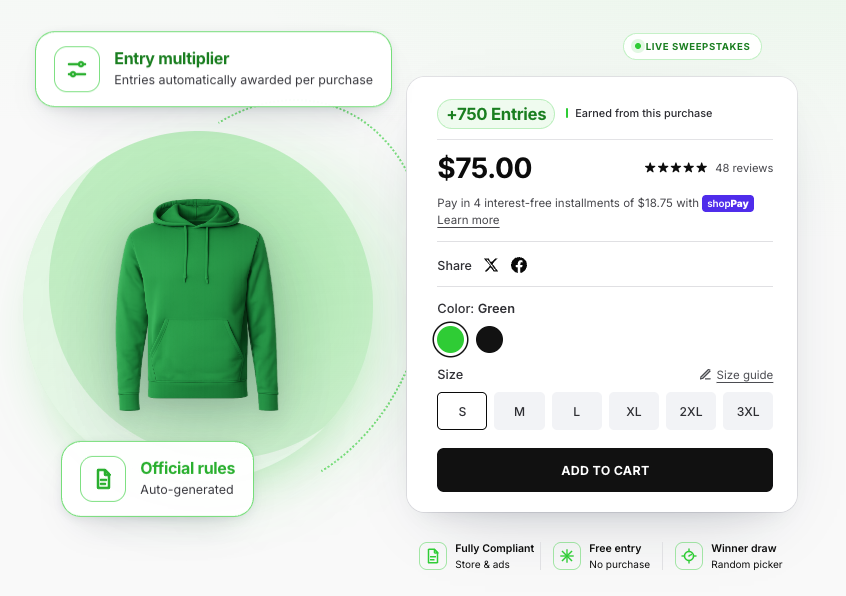
You set the rate (1 entry per dollar, 5 entries per dollar, whatever fits your AOV strategy), and from that moment on, every checkout on your store quietly becomes a participation event. No new flows. No customer friction. The “buy this hoodie” page now also says “+750 entries earned from this purchase.”
That single visual cue is doing more for your conversion rate than half your retargeting stack.
2. Official rules in under two minutes
Instead of paying a lawyer $400/hour to draft a document nobody reads, Sweeppea has a guided rules wizard. You answer a few questions about your campaign — prize, dates, eligibility, entry methods — and it generates publish-ready official rules. Compliant. Defensible. Done.
3. The free-entry problem, solved
Every legal US sweepstakes needs a “no purchase necessary” path, or it stops being a sweepstakes and starts being an illegal lottery. Sweeppea ships this by default — a clean free-entry form that satisfies the requirement without cannibalizing your buy-to-enter campaign.
4. One-click winner draws
When the campaign ends, you click a button. The system runs a random, audited drawing, picks a winner, logs everything, and notifies your team. No spreadsheet roulette. No “wait, did Brett’s cousin actually win this?” awkwardness.
5. The grown-up stuff: 1099s, affidavits, releases
For prizes that cross IRS reporting thresholds, the platform handles tax forms and winner liability releases. For Florida and New York, it handles state bonding and registration on the higher-tier plans. This is the boring infrastructure that separates a marketing stunt from a real promotional campaign.
What this actually looks like in practice
Imagine you run a mid-sized Shopify apparel store. AOV is $68. You want to run a holiday push.
Without Sweeppea, your options look like this:
- Discount harder. Margin compression. Race to the bottom. Trains your customers to wait for sales.
- Run more ads. Already expensive. Already plateauing.
- Try a giveaway. Probably accidentally illegal. Gets you 200 emails of dubious quality.
With Sweeppea, the playbook changes:
- Pick a prize ($1,000 store credit, a featured product bundle, an experience)
- Run the rules wizard
- Set “1 entry per $1 spent”
- Launch the campaign with an email blast and a homepage banner: “Every dollar you spend this month earns you entries to win [prize].”
- Watch AOV climb because customers are now optimizing for entries, not just product
- Run the drawing on January 2nd, ship the prize, file the 1099
The campaign costs you the prize and the platform fee. Everything else — the entries, the legal compliance, the audit trail — happens on autopilot.
Why this works (the psychological argument)
There’s a reason casinos exist and lottery tickets sell despite terrible expected value. Humans are non-linearly motivated by the possibility of a windfall.
A 1-in-10,000 chance to win something meaningful feels qualitatively different from a 0-in-anything chance. The brain treats the introduction of any upside asymmetry as a complete reframing of the transaction.
This is why “spend $75, earn 750 entries” outperforms “spend $75” so reliably. You haven’t changed the price. You haven’t changed the product. You’ve changed what the transaction means.
And in a market where everyone is competing on price, free shipping, and faster delivery, changing what the transaction means is one of the only moves left.
The integration question
Sweeppea slots into the stack most Shopify stores already run:
- Shopify (obviously) — installs in one click
- Klaviyo, Mailchimp, Shopify Email — entries become email list growth, not just contest noise
- Meta Ads, Google Ads — campaigns become ad creative (“Every order this month earns entries to win…”)
- CRM exports — participant lists are export-ready, not trapped in a black box
For agencies and enterprise operators, there’s an API and an MCP server (yes, an MCP server — for the AI-agent-curious among you) so you can plug sweepstakes administration into whatever weird automation pipeline you’ve built.
The catch
There’s always a catch. Here’s this one: sweepstakes only work if your offer is real and your prize is real.
If you run a “win a $50 gift card” campaign on a store with $400 AOV, customers will yawn. If you run a “win a year of free product” campaign on a store with strong brand affinity, customers will evangelize it.
Sweeppea is infrastructure. It doesn’t fix bad creative. It doesn’t rescue a weak prize. It doesn’t manufacture brand love. What it does — and the only thing it claims to do — is remove every legal, operational, and administrative reason you’ve been telling yourself not to run sweepstakes.
Which, for most Shopify stores, is the only thing that’s been stopping them.
The bottom line
If you’ve ever sat in a marketing meeting and said the words “we should do a giveaway” and then never actually done one — this is for you.
If you’ve ever launched a contest, panicked about whether you needed a lawyer, and then quietly let it die — this is for you.
If you’re staring at a flat AOV chart wondering what lever you haven’t pulled — this is the lever you haven’t pulled.
There’s a free plan. There’s no credit card required. There’s a 4.9-star rating from merchants who, like you, were probably skeptical until they ran the math.
The fastest-growing Shopify stores are turning purchases into entries. They’re doing it legally. They’re doing it at scale. And they started by clicking one link.
👉 Take a look at Sweeppea for Shopify →
Your $1 was already going to be spent somewhere. The question is whether it could also be a chance to win something.